The Odyssey ~ Review
By: [email protected] on
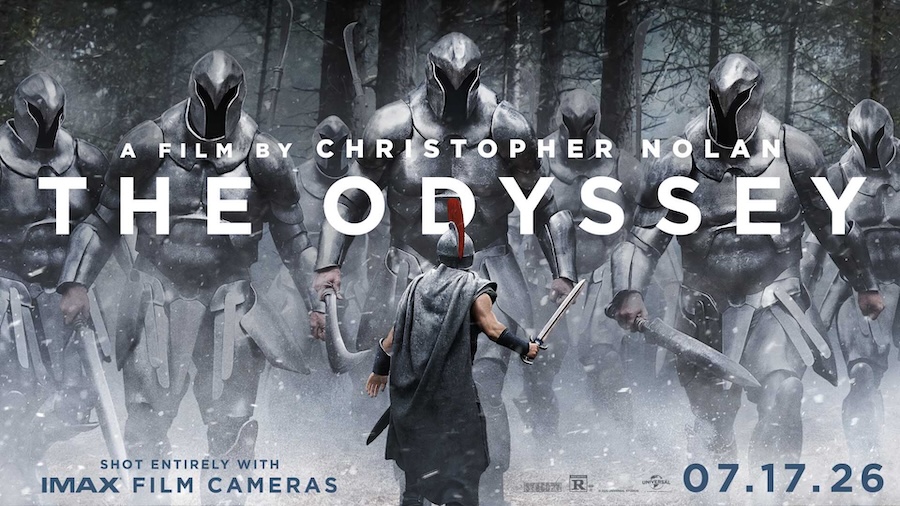
I don’t think it’s a novel idea to say that Christopher Nolan has been telling stories about stories for his entire career. Whether it’s about the lies we tell ourselves to keep going (Memento), the myths we use to cope with our grief and inspire others (The Dark Knight trilogy), or the dreams that tell us we can be better people (Inception). Or the stories told about us and how the world has been reshaped by our actions (Oppenheimer).
Okay, for those of you who haven’t been in freshman lit class in decades, here’s a summary of the roughly 2,000-year-old poem: The Trojan War took ten excruciatingly long years. The conflict was between the Greeks and the Trojans. The Greeks were led by Agamemnon (Benny Safdie) to recapture his brother Menelaus’ (Jon Bernthal) wife Helen of Sparta (Lupita Nyong'o), who had been taken by Paris, a prince of Troy (not in this film). One of the warriors assembled to fight in this war was the king of Ithaca named Odysseus (Matt Damon), and at the end of the conflict he came up with a cunning plan -- a hollow wooden horse would be offered to the Trojans as a gift, but the horse would be filled with Greek soldiers. Odysseus’ plan works, and the Greeks manage to sack Troy, and everyone returns home (sort of).
However, as The Odyssey opens, it’s been eight years since Troy fell. Odysseus has not returned home, leaving his wife Penelope (Anne Hathaway) and young son Telemachus (Tom Holland) to fend off a group of suitors led by Antinous (Robert Pattinson) who are all trying to court Penelope and take up residence in Odysseus’ castle. Penelope and Telemachus cannot hold out for much longer. So, Telemachus goes on a voyage to find his father’s whereabouts. Meanwhile, Odysseus is stuck with amnesia on the nymph Calypso’s (Charlize Theron) island. He’s haunted by nightmarish visions of the Trojan War and struggling to remember his family, home, and crew.
The story is split between Telemachus learning about the fall of Troy, Penelope and the scheming suitors, and Odysseus’ memory of what happened after. Most of the episodes from the epic that you all remember from high school are here: Polyphemus the cyclops (Bill Irwin), Circe the witch (Samantha Morton), the Sirens, and the journey to the underworld. These episodes are all bravura set pieces of just simply astonishing filmmaking. The cyclops is genuinely horrifying, and when Circe turns Odysseus’ men into pigs, it is a body horror nightmare out of John Carpenter’s The Thing. If any one of these sequences were in a movie on their own, you’d call that film the best of the year, but this film contains five! The film was shot entirely in IMAX, and the scope of the story genuinely deserves to be seen in that format. I’m truly in awe of the scale and ambition of this film.
In his 1988 masterpiece The Last Temptation of Christ, Martin Scorsese made a unique stylistic choice in how he portrayed the dialogue. The accents for Christ and his followers were all American English. The idea being that these were people of a lower class and wouldn’t speak in faux-Shakespearean dialogue. Nolan employs the same trick here; the actors all speak with modern American accents and dialogue. I’ll admit it’s a little jarring at first; however, it pulled me into the story in a way that more high-minded dialogue might not have.
This anachronistic sentiment is carried into the production design and the general world-building of Nolan’s interpretation of the Bronze Age. None of the weapons, armor, or ships are strictly speaking historically accurate. But Nolan is not trying to make a historically accurate Odyssey; instead, he’s created a mythic reality where different eras combine in a surreal dreamlike space where gods, monsters, and magic all co-exist, without feeling like Lord of the Rings. This also extends to the film’s arrhythmic editing style, which I can only describe as jazz-like. The film is not structured like a typical Hollywood blockbuster; it jumps between time and stories as the emotion fits. This too, I found jarring at first, especially in the opening thirty minutes where Nolan does not hold your hand getting you up to speed on things. However, once I grooved to the film’s vibe, I really enjoyed it.
The Odyssey has an enormous cast. In that way, it feels like a Hollywood epic from the 50s, so talking about the cast will make this long review even longer. I will say everyone across the board is fantastic; even actors who appear for brief moments and scenes leave their mark, particularly Elliot Page as Sinon, Samantha Morton as Circe, John Leguizamo as swineherd Eumaeus, Himesh Patel as Odysseus’ right-hand man Eurylochus, and Zendaya as a quiet and mournful Athena.
Matt Damon gives one of the best performances of his career as the cunning and crafty Odysseus. He’s haunted and devastated by his actions during the Trojan War, but Damon also brings the humor, pride, and physicality of the character to life as well. Anne Hathaway’s Penelope is full of grace and a fiery temper. Tom Holland is basically playing a bronze-age version of Peter Parker, but he’s great here as a boy desperately trying to be given the chance to become a man. And Robert Pattinson devours the scenery as a slimy little worm.
Christopher Nolan’s The Odyssey is about the stories we tell others and the stories we tell ourselves to stay sane. It’s a film that plays with time, memory, and dreams to transport us to a mythic world crumbling under the stories it tells itself about decency. It is Nolan’s magnum opus, and a masterpiece.
Four out of Four Stars
 WhoRepresents.com is safe & secure