Digger ~ Review
By: [email protected] on
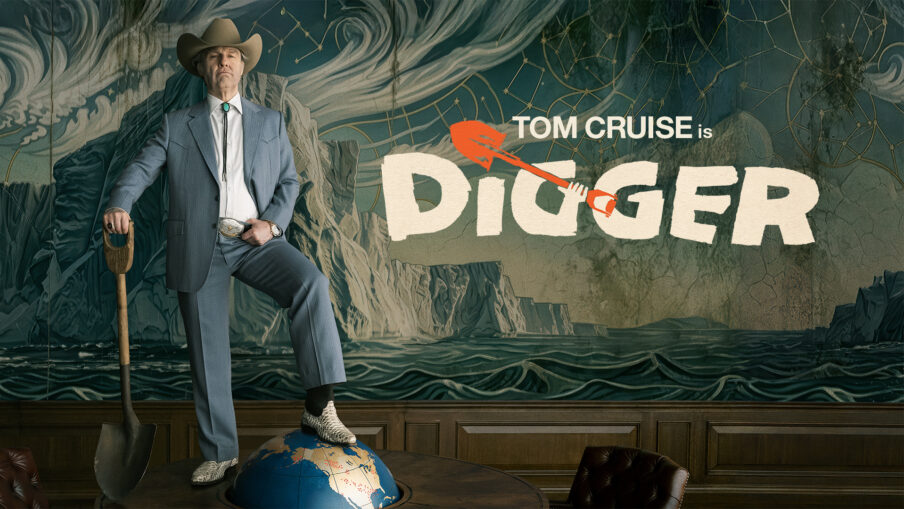
I can’t really discuss Alejandro González Iñárritu’s Digger without spoilers. So, I'll give my assessment here, and once you see the movie, you can come back and read my analysis. The film is best enjoyed with as little context as possible, because the marketing DOES NOT give you the full picture of what this movie is all about. Digger is an extremely ambitious, wildly entertaining mess. It is worth seeing, particularly Tom Cruise and John Goodman’s completely unhinged performances. The film doesn’t totally work, but who cares when it’s this engaging.
Okay, you’ve been warned, spoilers ahead. Oh, and also spoilers for Preston Sturges’ 1941 film Sullivan’s Travels. Yeah, Digger is weird.
Preston Sturges’ Sullivan’s Travels is one of the oddest comedies ever made. Set at the tail end of the great depression, it is a metatextual story about John Sullivan, a comedy filmmaker working on his next film. Concerned that nobody needs comedies, he endeavors to make a film that will speak to the downtrodden common man. To research the new movie, Sullivan decides to live like a common man. Through plot machinations, he ends up in a prison work camp, leading to Sullivan’s Travels' most famous scene, where the prisoners are taken to an old church to watch a movie. Sullivan watches the prisoners laugh uproariously at a Pluto cartoon, and realizes how important comedy is in trying times.
I don’t think Alejandro González Iñárritu is worried about the state of comedy, but he is concerned about what art can mean while the world burns around us. Digger begins as a broad satire like Dr. Strangelove and gradually becomes a treatise on the nature of art. Are these two tones incompatible? Yes. Do these two tones completely undermine each other? Also, yes. But goddamn, is the result not entertaining.
In the not-too-distant future, the aging Digger Rockwell (Tom Cruise) is one of the most successful oil barons of his age. Digger is so successful that he’s bribed his way into drilling in both Alaska and Greenland. While Digger makes gestures to caring about people, his sister Emma (Sandra Hüller), the one thing other than money that he truly cares about is his 30-year-old cat Maggie, who is currently dying and portrayed by a horrifying animatronic. Anyway, one of Digger’s drilling operations causes an enormous methane gas explosion, sending an ice shelf the size of Maryland to smash into the coast of Norway. Digger brings in his chief environmental scientist, Dr. Ganesh (Riz Ahmed), along with the United States President (John Goodman) and his cabinet (Michael Stuhlbarg, Burn Gorman, and Robert John Burke), who are quickly brought in to manage the incoming disaster.
So the film presents an extremely broad and cartoonish satire. At times, it parodies 1970s disaster movies, lavish Oscar-bait biopics, and Oscar-bait message movies (such as Don’t Look Up). At other times, it is a farce with slamming doors and pratfalls. Dialogue is not spoken but shouted to the rafters. Meanwhile, Cruise gives his performance from Tropic Thunder a run for its money in just how over the top he can go. And in its own weird, kind of bad way, this is fun, and just as you get into the movie’s groove, Digger deploys its first twist. See, we aren’t watching a movie; we are watching actors rehearse a play. Cruise drops the accent and becomes an actor named Curtis Markson who feels that the script might be too over the top. This presents a problem for the film, as Digger’s story is now undercut because the audience knows it’s not, strictly speaking, real. Meanwhile, in the real world, Curtis is dealing with his own family problems, namely that his daughter might be caught in a strange weather event.
The film continues in this bifurcated manner, telling a broad satire about how Digger and his enablers in the United States military-industrial complex proceed to destroy the world through their buffoonish actions. Eventually, this leads to Digger’s final twist. The play is called Fossil Fools, a satire about the real-life Digger whose actions destroyed the world and turned it into a hellish, post-apocalyptic, flooded dystopia. And while this turn is more effective and gives much-needed context to the real-world portion of the story, it can’t help but make the film feel like two different movies smashed together. The result is what I expect a feature film version of one of Max Fisher’s plays from Rushmore would be like. But here’s the thing, I can’t quite get the movie out of my head.
Cruise is fantastic as Digger, and it’s always fun to see him play a big weirdo on screen. What’s more interesting about his performance is that he has to play an actor overacting as Digger – desperately trying to give this truly vile person and over-the-top personality some shred of nuance. Iñárritu’s direction here is like Terry Gilliam on meth in the play sequences and more grounded in the real-world sequences; in fact, those moments feel the most down to Earth in the whole film.
Turning it over and over in my mind, I cannot say Digger is a bad film. Ambitious and messy, sure, but it’s got style and an offbeat sensibility that I can’t help but like. I think the film will be a cult object in a decade or more.
John Sullivan’s final line in Sullivan’s Travels is this: “There’s a lot to be said for making people laugh. Did you know that’s all people have? It isn’t much, but it’s better than nothing in this cockeyed caravan.” This sentiment is echoed in some of the speeches throughout Digger’s runtime. And I can’t help but feel that Iñárritu is trying to have it both ways, get us to laugh at the people destroying our planet, but also think about how to save it. Maybe laughing at the fools who are killing us just isn’t enough if we’re actively being murdered. But then again, Iñárritu is making a movie about us laughing at the people who are trying to kill us and not actively pushing for change and…I think the metaness of it all just gave me a headache.
Two Stars out of Four
 WhoRepresents.com is safe & secure